The Paracel and Spratly Islands are an inseparable part of Vietnam's territory.

  • Blog & promotions
  • Contact
  • Account
    • Log in
    • Sign up
  • EN
    • Vietnamese
    • English
    • 日本語
    • 한국어
    • 简体中文
HiTechCloud
HiTech Cloud
  • Domains

    A great domain makes a strong brand

    View details
    Register a domain

    Register a domain

    A great domain makes a strong brand

    Domain lifecycle lookup – domain WHOIS

    Domain lifecycle lookup – domain WHOIS

    Domain lifecycle lookup - Domain WHOIS

    IT.COM domains

    IT.COM domains

    A premium domain for the information technology industry

  • Cloud computing

    Cloud computing

    Services on dedicated infrastructure, delivered in whichever model fits the customer's needs.

    Cloud Server 2026

    Cloud Server 2026

    Next-generation cloud infrastructure with outstanding performance

    Cloud Server AMD EPYC™

    Cloud Server AMD EPYC™

    Peak performance on AMD EPYC™ and NVMe storage, ready for AI workloads

    Dedicated Private Cloud

    Dedicated Private Cloud

    High-performance private cloud that meets the security and compliance needs of large enterprises

    VMware Virtualisation

    VMware Virtualisation

    VMware virtualization that optimizes cost and availability for your business

    Cloud VDS

    Cloud VDS

    High-performance virtual private servers at an optimized cost

    Cloud Server OpenClaw

    Cloud Server OpenClaw

    A personal AI assistant that automates work and runs securely on your own infrastructure

    Cloud Hermes Agent

    Cloud Hermes Agent

    A self-learning, self-scaling AI agent that runs on your own Cloud Server

    Auto Scaling

    Auto Scaling

    Scale Elastic Compute up or down with actual load

  • DevOps

    Infrastructure designed to help customers build and deliver reliable cloud services and cost-effective DevOps practices.

    View details
    Cloud Instances

    Cloud Instances

    Flexible cloud servers for business

    vCloudstack

    vCloudstack

    Private cloud for your business.

    Managed Services – IT infrastructure management

    Managed Services – IT infrastructure management

    Deploy and operate IT systems

    Managed Kubernetes Service (vMKS)

    Managed Kubernetes Service (vMKS)

    Deploy applications fast on Kubernetes, fully managed by HiTechCloud

  • Licensed software

    Remove risk and run reliably on genuine international software licenses at Vietnamese prices

    View details
    Microsoft software

    Microsoft software

    Microsoft 365, Office, Windows, Microsoft SPLA, and AI Cloud Solutions

    cPanel/WHM

    cPanel/WHM

    A professional hosting control panel

    DirectAdmin

    DirectAdmin

    High performance, with easy management of websites, email, DNS and servers

    Plesk

    Plesk

    A cross-platform hosting control panel

    CloudLinux

    CloudLinux

    Optimize hosting performance and security

    JetBackup

    JetBackup

    Backup for hosting

    Imunify360

    Imunify360

    Complete hosting server security

    LiteSpeed Enterprise

    LiteSpeed Enterprise

    A high-performance web server

  • Partners & resellers

    HiTechCloud is committed to long-term partnership and shared growth

    View details

    Partner network

    The vendors and providers behind each layer of HiTechCloud services

    Partner & reseller program

    Partner & reseller program

    HiTechCloud is committed to long-term partnership and shared growth

    Affiliate program

    Affiliate program

    Refer users to HiTechCloud services and earn competitive commission.

  • About HiTechCloud

    About HiTechCloud

    View details
    About

    About

    Hello, we are HiTechCloud

    Technology

    The technology groups HiTechCloud runs, and the certifications behind them

    Internet resources

    IPv4, IPv6, ASN and BGP routing

    Success stories

    Success stories

    HiTechCloud Success story

    Our direction

    Our direction

    HiTechCloud development orientation

    Company profile

    Company profile

    HiTechCloud company profile

    Blog & promotions

    Blog & promotions

    Blog and promotions from HiTechCloud

    Contact

    Contact

    Contact us for 24/7 support

    Careers

    Career opportunities across the group

HiTechCloud
EN
VietnameseEnglish日本語한국어简体中文
Account
Log inSign up

Multi-cloud strategy for Vietnamese SMEs: risks, benefits and when it is genuinely necessary

ByHiTechCloud 15/06/202614/08/2026

If you are already running some workloads on AWS and are thinking about adding one more cloud provider — you are not alone. According to a Gartner survey, most companies become “accidentally multi-cloud” before they have a clear strategy: acquisitions, different teams picking different tools, or simply trials that were never cleaned up.

But “accidentally multi-cloud” and “strategically multi-cloud” are very different things in cost, complexity and outcome.

This article is not trying to push you in either direction. Its purpose is to help you answer a practical question: at your SME's current size and with its current resources, is multi-cloud the right choice or expensive over-engineering?

1. What is multi-cloud? How does it differ from hybrid cloud?

The two terms are often used interchangeably but have clearly different meanings, and the confusion frequently leads to the wrong decision.

Multi-cloud là chiến lược sử dụng dịch vụ từ hai hoặc nhiều cloud provider công cộng cho cùng loại workload. Ví dụ: chạy app trên AWS, dùng HiTechCloud cho workload AI vì GPU rẻ hơn và data cần ở Việt Nam, dùng Cloudflare cho CDN. Tất cả đều là public cloud, nhưng từ các provider khác nhau.

Hybrid cloud là sự kết hợp giữa hạ tầng on-premise (or private cloud) với public cloud. Ví dụ: database quan trọng chạy trên server vật lý tại văn phòng, ứng dụng web chạy trên public cloud. Focus của hybrid cloud là kết nối on-premise và cloud — không nhất thiết liên quan đến nhiều cloud provider.

Quick comparison table:

 Multi-cloud Hybrid cloud 
Number of providers≥ 2 public cloud 1+ public cloud + on-premise/private 
Core problem it solvesAvoid lock-in, best-of-breedConnect legacy systems with the new cloud
ComplexityCao Medium to high
Right for SMEs?ConditionalUsually a better fit

Many Vietnamese SMEs are in fact running hybrid cloud (on-premises servers plus some services in the cloud) but call it multi-cloud. Telling the two apart helps you pick the right strategy for the problem you actually have.

2. Why Vietnamese SMEs are actually considering multi-cloud

Unlike the textbook theory of “vendor lock-in avoidance” and “best-of-breed selection”, Vietnamese SMEs usually look at multi-cloud for far more specific and practical reasons:
mc_fig3_patterns_v2_vi.png

Reason 1: compliance and data sovereignty.Data Law 2025 (Luật Dữ liệu 2025) and PDPL 2026requires certain categories of sensitive data to be processed on domestic infrastructure. If an SME runs its entire workload on AWS Singapore, that is a mandatory trigger to consider adding a domestic cloud provider — not because multi-cloud is desirable, but because compliance requires it.

Reason 2: GPU and AI workload costs.Startups and tech SMEs are building more and more AI features. GPUs on AWS or GCP cost considerably more than on some domestic providers or specialized GPU clouds. Using a separate provider for AI training and inference while keeping the main application on the existing provider is a common pattern.

Reason 3: Latency for users in Vietnam.AWS Singapore has higher latency for domestic users than a data center in Hanoi or Ho Chi Minh City. For consumer apps or SaaS with a large Vietnamese user base, adding a CDN or placing some workloads on a domestic cloud is a reasonable move.

Reason 4: disaster recovery and redundancy.Some SMEs want to avoid depending entirely on a single provider — if one provider has a prolonged incident, they can fail over to another. This is a legitimate reason, but how necessary it is tends to be overestimated.

Reason 5: teams adopt many different tools on their own.The most common reality: marketing uses a SaaS product running on Azure, engineering uses AWS, and the data team is trying GCP for BigQuery. This is “accidentally multi-cloud” — not a strategy, but entropy.

3. The real risks: complexity, cost, skills gap

Before committing to multi-cloud, look honestly at what you are taking on:

3.1 Complexity grows exponentially, not linearly

With a single cloud provider you learn one console, one IAM system, one billing dashboard, one networking model, one support channel.

With two cloud providers the effort is not doubled — it is multiplied, because you also have to manage the differences between the two environments. The networking models of AWS and HiTechCloud differ. IAM policies differ. Debugging a network issue differs. Reading the bill differs.

Every incident forces your engineers to context-switch between two environments instead of debugging one familiar system.

3.2 Operating costs are usually underestimated

The visible costs of multi-cloud: licenses, compute and storage.

Hidden costs are usually higher:

Data egress fees: moving data between two cloud providers is normally billed as outbound bandwidth by the sending provider. For workloads with large data transfer volumes this can be a significant cost.

Engineering time: maintaining two sets of Infrastructure-as-Code, two CI/CD pipeline configurations and two monitoring stacks. For a small team, that is a significant percentage of time not spent on feature development.

Tooling: multi-cloud management tools (Terraform, cross-cloud monitoring, cloud cost management) carry their own license costs and learning curve.

Training: engineers need training to be competent on both platforms.

3.3 Skills gap — a real problem for Vietnamese SMEs

A shortage of experienced cloud staff is one of the biggest challenges facing Vietnamese SMEs today. Finding a strong AWS engineer is already hard; finding someone strong in both AWS and a second provider who can also design cross-cloud architecture is far harder.

If your engineering team is already stretched, adding a second cloud provider adds surface area for things to go wrong without adding anyone to deal with it.

4. When do SMEs actually need multi-cloud?

To be honest, these are the cases where multi-cloud delivers real ROI — not just in theory:

Case 1: Compliance requires workload separation. If the Data Law 2025 (Luật Dữ liệu 2025) and the PDPL 2026 (Personal Data Protection Law) require part of your data to sit on domestic infrastructure, but you have another workload with no such requirement that is running well on international cloud — that is the most valid reason to go multi-cloud. Not to avoid vendor lock-in, but because the law requires geographic separation.

Case 2: the workloads genuinely have distinct requirements. One provider offers H100 GPUs at a materially better price for AI training, while another is better for web serving. If the two workloads do not need to talk to each other much and can run independently, the complexity cost is significantly lower. The test to apply: if the two workloads need to transfer data frequently, egress fees and latency will erode the cost advantage.

Case 3: serious DR with a genuinely low RTO. If downtime genuinely costs you money by the minute — a payments platform or an exchange, for example — and you need an RTO under 15 minutes, multi-cloud DR can be justified. But do the arithmetic honestly: weigh the cost of maintaining a hot standby with a second provider against the probability and duration of a single-provider outage. For most SMEs, a good provider's SLA plus a sound backup strategy is enough.

Case 4: an enterprise customer requires it. Some enterprise customers have a policy that a vendor must not depend entirely on a single cloud provider. If that is a condition of winning the contract, the business case is clear.

5. When is one cloud provider enough — and better?

This is the answer many multi-cloud articles avoid stating plainly: for most Vietnamese SMEs at their current stage, one good cloud provider is a better choice than multi-cloud.

Specific reason:

You are building, not optimizing yet. The growth phase calls for fast deployment speed, fast iteration, fast debugging. A familiar environment lets your team do all of this faster. Multi-cloud optimizes for resilience and flexibility — things that matter more at the mature stage.

Teams of fewer than 10 engineers. On a small team, every engineer-hour spent on infrastructure management is an hour not spent on the product. Multi-cloud multiplies that cost considerably.

The workload is not large enough to justify the egress cost. If data transfer between providers costs more than the compute price advantage, multi-cloud is more expensive than single-cloud.

No one with cross-cloud experience. Rolling out multi-cloud without someone who understands both platforms usually leads to architecture debt — temporary decisions become permanent, and fixing them later costs twice the effort.

Self-assessment checklist — are you ready for multi-cloud:

  • The team has at least one engineer with hands-on experience on both platforms
  • There is a workload genuinely better suited to a second provider (not just “worth a try”)
  • Data transfer between the two providers is not a daily operation
  • Has the bandwidth to maintain two sets of IaC, monitoring and CI/CD
  • There is a clear business case (compliance, cost or a contract requirement)

If you cannot check at least 3 of the 5, single-cloud with one good provider is the better choice for now.

6. If you go multi-cloud: which pattern suits Vietnamese SMEs?

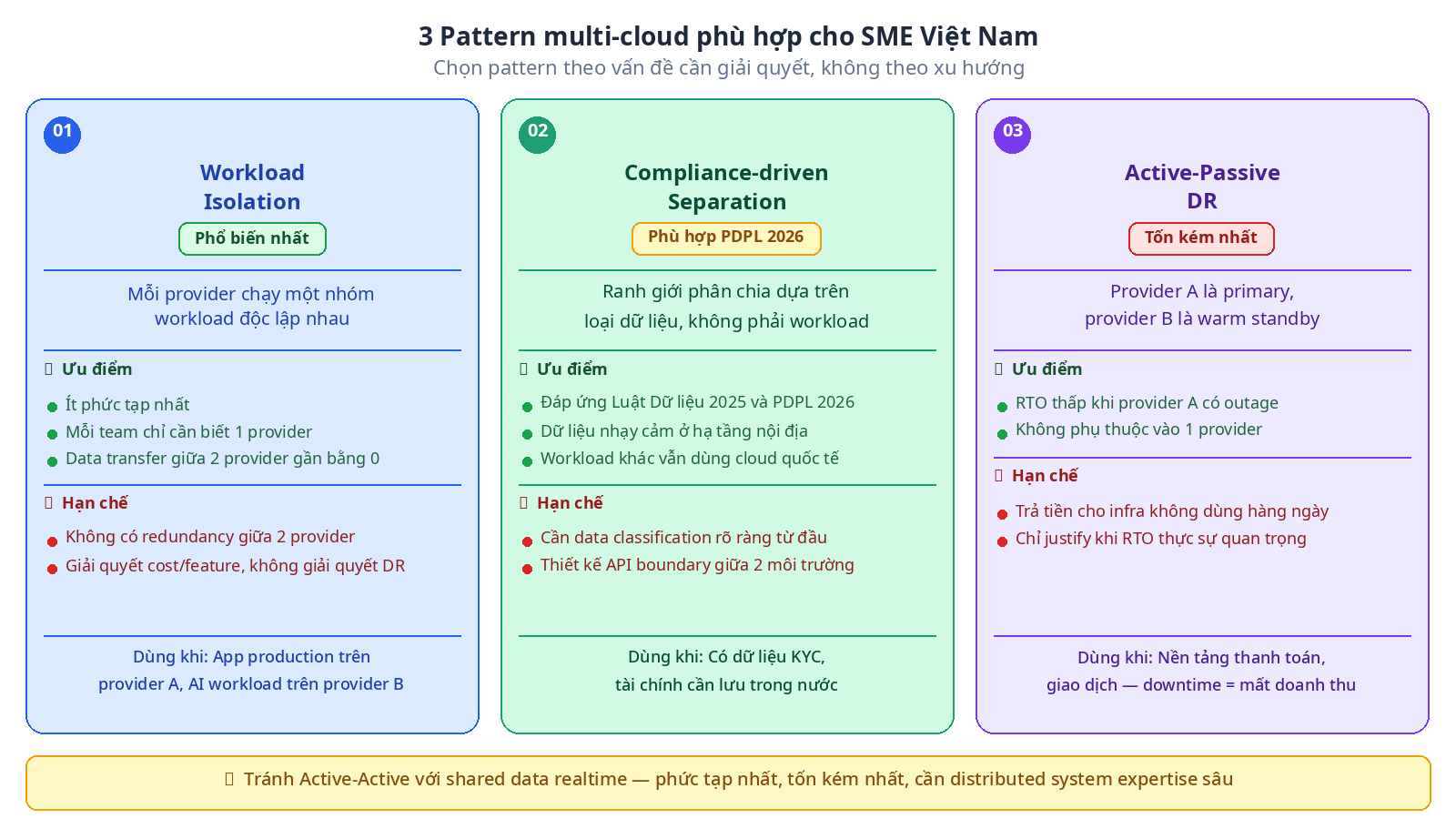
If you have worked through the checklist above and decided on multi-cloud, there are 3 common, practical patterns for SMEs:

Pattern 1: workload isolation (the most common)

Each cloud provider runs a different set of workloads, almost entirely independently. There is no regular data flow between the two providers.

Example: production app and database on provider A. AI training and model serving on provider B, which has better GPUs. The two sides communicate over APIs at acceptable latency and do not need real-time data sync.

This is the least complex pattern, because each provider operates as its own silo — team A knows provider A, team B knows provider B, and nobody needs deep knowledge of both.

Pattern 2: Compliance-driven separation

Workloads that process sensitive data (as defined by the Data Law 2025, Luật Dữ liệu 2025) run on a domestic provider. Non-sensitive workloads (static assets, CDN, dev environments) run on an international provider.

The boundary between the two providers is defined by data type, not by workload type. The data flow needs careful design so that no sensitive data leaks across to the foreign provider — this is the hardest part of the pattern.

Pattern 3: Active-passive DR

Provider A is primary and runs all of production. Provider B is a warm standby with data synced on a schedule. If provider A has a prolonged outage, you fail over to provider B.

This pattern is the simplest to run day to day but the most expensive, because you are paying for infrastructure that goes unused most of the time. It is only justified when the RTO requirement is genuinely low and the business case is clear.

The pattern SMEs should avoid: active-active with data shared in real time between two providers. This is the most complex architecture, the most expensive in egress and latency, and it demands distributed systems expertise that most SMEs do not have.

7. HiTechCloud plus an overseas cloud: a practical hybrid model

This is the specific pattern many Vietnamese SMEs and startups are adopting — not because it is the best solution in theory, but because it meets two practical requirements at once:

Requirement 1: compliance. Vietnamese user data, financial information and sensitive data must sit on domestic infrastructure under the Data Law 2025 (Luật Dữ liệu 2025) and the PDPL 2026.

Requirement 2: ecosystem and tooling. Some managed services, marketplaces or third-party integrations exist only on the international hyperscalers and are hard to replicate on a domestic provider.

8. How to split workloads in this pattern

On HiTechCloud (domestic VN):

  • Workloads processing the personal data of Vietnamese users
  • Production databases holding customer information
  • AI/ML workloads withGPU(H100 GPUs at competitive pricing, with no cross-border data transfer for sensitive data)
  • Backup and DR for critical data
  • Workloads that need low latency for users in Vietnam

On international clouds:

  • Workloads that do not handle sensitive data (static content, build pipelines, dev environments)
  • A managed service that domestic providers do not offer, or have not matured
  • Global CDN edge nodes (non-sensitive data)
  • Offsite disaster recovery on request

9. What needs careful design

Classify your data clearly before you build. Every type of data needs to be classified: is it “important data” under the Law on Data 2025 (Luật Dữ liệu 2025)? If it is, it may only be processed on HiTechCloud. Skip this step and you will discover the compliance risk only after the architecture has been built.

An API boundary between the two environments. Services on an international cloud should not have direct access to databases holding sensitive data on HiTechCloud. All communication must go through APIs with full authentication and logging.

Centralized monitoring. Even with workloads running on two providers, you need a single monitoring dashboard so you are not checking two different consoles during an incident.

This model is not for everyone. It fits when you already have workloads running well on an international cloud and only need to add a compliance layer for sensitive data — not a full migration.

Conclusion: multi-cloud is not a destination, it is a tool

Multi-cloud is indeed a trend — but a trend among enterprises with large engineering teams and enough resources to manage the complexity. For most Vietnamese SMEs at their current stage, one good cloud provider, operated well, remains the superior choice in terms of overall ROI.

The right question to ask is not “should we adopt multi-cloud?” but rather: “what specific problem do we have, and is multi-cloud the least expensive way to solve it?”

If the problem is compliance, the answer is usually to add a domestic provider for the sensitive data — that is deliberate multi-cloud, not multi-cloud for its own sake.

If the concern is vendor lock-in, the answer is usually to write code to best practice (12-factor app, container-first, IaC) so that it stays portable — not necessarily to run on two providers today.

If the issue is cost, review your current bill and optimize before adding another provider.

Post Tags: #bussiness#hitechcloud
HiTechCloud

Hi-Tech Cloud, part of Pho Tue SoftWare Solutions JSC, provides VPS hosting, server hosting, Cloud Server, colocation, hosting and domains — Cloud VPS and servers, Dedicated Servers, Colocation Server, Web Design, source code, plugins and more.

Facebook

Similar Posts

  • Vietnam's submarine cables hit by another fault - latest cable status update June 30, 2023

    Vietnam's submarine cables hit by another fault - latest cable status update June 30, 2023

    According to a source at a Vietnamese internet service provider, on 29/6 the operator of the submarine cable route…

  • What is a VDC (Virtual Data Center)? Why it matters

    What is a VDC (Virtual Data Center)? Why it matters

    VDC, or virtual data center, is a relatively new term - not everyone working in the field…

  • For March 8, save up to 83% on Hi-Tech Cloud products: NVMe Hosting, NVMe VPS, Singapore Hosting, BMail, SSD Hosting

    For March 8, save up to 83% on Hi-Tech Cloud products: NVMe Hosting, NVMe VPS, Singapore Hosting, BMail, SSD Hosting

    Dear customers, On the occasion of International Women's Day on March 8, HiTechCloud is pleased to offer you a special promo…

  • Websites for earning money online to add to your monthly income in 2023

    Websites for earning money online to add to your monthly income in 2023

    Looking for effective and safe ways to earn money online? Want extra income each month without…

  • Windows VPS and effective ways to secure it

    Windows VPS and effective ways to secure it

    1. Disable the default Admin account and create a new administrator. When you order a Windows VPS, the provider usually installs…

  • What is an NPU? How it differs from a CPU and a GPU

    What is an NPU? How it differs from a CPU and a GPU

    As demand grows for fast, efficient data processing, processor types such as the NPU have become…

Promotions

  • HiTechCloud by Pho Tue SoftWare Solutions JSC launches AI Factory in Vietnam, Japan and Korea

    HiTechCloud by Pho Tue SoftWare Solutions JSC launches AI Factory in Vietnam, Japan and Korea

  • An introduction to the IT.COM domain – an ideal fit for technology companies and developers

    An introduction to the IT.COM domain – an ideal fit for technology companies and developers

  • What is HostBill? A complete customer and billing management solution for web hosting

    What is HostBill? A complete customer and billing management solution for web hosting

  • Multi-cloud strategy for Vietnamese SMEs: risks, benefits and when it is genuinely necessary

    Multi-cloud strategy for Vietnamese SMEs: risks, benefits and when it is genuinely necessary

  • Cloud migration and the cloud continuum as a competitive advantage

    Cloud migration and the cloud continuum as a competitive advantage

  • HiTechCloud by Pho Tue SoftWare Solutions JSC announces a support program for Vietnamese startups worth billions of dong

    HiTechCloud by Pho Tue SoftWare Solutions JSC announces a support program for Vietnamese startups worth billions of dong

Recommended

  • Why your business needs a website

    Why your business needs a website

  • The benefits of deploying VPS instead of dedicated servers

    The benefits of deploying VPS instead of dedicated servers

  • Why a website matters for protecting your brand

    Why a website matters for protecting your brand

  • Digital transformation for business: the benefits and the challenges

    Digital transformation for business: the benefits and the challenges

  • 5 steps to run Google Workspace and Cloud Email side by side at HiTechCloud

    5 steps to run Google Workspace and Cloud Email side by side at HiTechCloud

  • Multi-cloud strategy for Vietnamese SMEs: risks, benefits and when it is genuinely necessary

    Multi-cloud strategy for Vietnamese SMEs: risks, benefits and when it is genuinely necessary

  • What is HiTechCloud IDP? Understanding Intelligent Document Processing and how Vietnamese businesses use it

    What is HiTechCloud IDP? Understanding Intelligent Document Processing and how Vietnamese businesses use it

TRUSTED BY 85,000+ CUSTOMERS IN VIETNAM AND WORLDWIDE

HiTechCloud Partner
HiTechCloud Partner
HiTechCloud Partner
HiTechCloud Partner
HiTechCloud Partner
HiTechCloud Partner
HiTechCloud Partner
HiTechCloud Partner
HiTechCloud Partner
HiTechCloud Partner
HiTechCloud Partner
HiTechCloud Partner
HiTechCloud Partner
HiTechCloud Partner
HiTechCloud Partner
HiTechCloud Partner
HiTechCloud Partner
HiTechCloud Partner
HiTechCloud Partner
HiTechCloud Partner
HiTechCloud Partner
HiTechCloud Partner
HiTechCloud Partner
HiTechCloud Partner
HiTechCloud Partner
HiTechCloud Partner
HiTechCloud Partner
HiTechCloud Partner
HiTechCloud Partner
HiTechCloud Partner
HiTechCloud Partner
HiTechCloud Partner
HiTechCloud Partner
HiTechCloud Partner
HiTechCloud Partner
HiTechCloud Partner
HiTechCloud Partner
HiTechCloud Partner
HiTechCloud Partner
HiTechCloud Partner
HiTechCloud Partner
HiTechCloud Partner
HiTechCloud Partner
HiTechCloud Partner
HiTechCloud Partner
HiTechCloud Partner
HiTechCloud Partner
HiTechCloud Partner
HiTechCloud Partner
HiTechCloud Partner
HiTechCloud Partner
HiTechCloud Partner

PARTNERS IN GROWTH

HiTechCloud Partner
HiTechCloud Partner
HiTechCloud Partner
HiTechCloud Partner
HiTechCloud Partner
HiTechCloud Partner
HiTechCloud Partner
HiTechCloud Partner
HiTechCloud Partner
HiTechCloud Partner
HiTechCloud Partner
HiTechCloud Partner
HiTechCloud Partner
HiTechCloud Partner
HiTechCloud Partner
HiTechCloud Partner
HiTechCloud Partner
HiTechCloud Partner
HiTechCloud Partner
HiTechCloud Partner
HiTechCloud Partner
HiTechCloud Partner
HiTechCloud Partner
HiTechCloud Partner
HiTechCloud Partner
HiTechCloud Partner
HiTechCloud Partner
HiTechCloud Partner
HiTechCloud Partner
HiTechCloud Partner
HiTechCloud Partner
HiTechCloud Partner
HiTechCloud Partner
HiTechCloud Partner
HiTechCloud Partner
HiTechCloud Partner
HiTechCloud Partner
HiTechCloud Partner
HiTechCloud Partner
HiTechCloud Partner
HiTechCloud Partner
HiTechCloud Partner
HiTechCloud Partner
HiTechCloud Partner
HiTechCloud Partner
HiTechCloud Partner
HiTechCloud Partner
HiTechCloud Partner
HiTechCloud Partner
HiTechCloud Partner
HiTechCloud Partner
HiTechCloud Partner
HiTechCloud Partner
HiTechCloud Partner
HiTechCloud Partner
HiTechCloud Partner
HiTechCloud Partner
HiTechCloud Partner
HiTechCloud Partner
HiTechCloud Partner
HiTechCloud Partner
HiTechCloud Partner
HiTechCloud Partner
HiTechCloud Partner
HiTechCloud Partner
HiTechCloud Partner

A handbook for building digital infrastructure with confidence

Help

Start deploying quickly with HiTechCloud

Documentation & supportSupportContactMy HiTechCloudPrivacy

Latest updates

Announcements, in-depth analysis and events

Webinars & events – promotionsBlogsStartup Program at HiTechCloud

International security certifications and standards

HiTechCloud AWS Advanced Tier Partner
HiTechCloud AWS Well-Architected Partner
HiTechCloud AWS DevOps Competency
HiTechCloud AWS 50 Certified
HiTechCloud SAP PartnerEdge
HiTechCloud ISO 9001:2015 – ISOCERT
HiTechCloud security certifications
HiTechCloud data center – Uptime Institute Tier III Design Certified
HiTechCloud data center – Uptime Institute Tier III Facility Certified
HiTechCloud ANSI/TIA-942:2017 Rated 3 Facilities
HiTechCloud TIA-942
ISO 27001
ISO 27017
ISO 27018
HiTechCloud ISO 27001:2013
HiTechCloud ISO/IEC 27010:2019
HiTechCloud ISO/IEC 20000-1:2018
HiTechCloud ISO 22301:2019
HiTechCloud ISO 22301
HiTechCloud ISO 9001:2015
HiTechCloud ISO 14001:2016
HiTechCloud ISO 45001:2018
HiTechCloud ISO Certification
HiTechCloud ISO
ISO 14001:2015
ISO Certified
ISO/IEC 27018 PII Public Clouds
HiTechCloud PCI DSS
PCI DSS
SISA PCI DSS
A-LIGN SOC 2
HiTechCloud AICPA SOC
TVRA
CREST
Cisco CCNP Security
JNCIA Junos
HiTechCloud CMMI
HiTechCloud ISTQB Gold Level
Cyber Security Certification
HiTechCloud Vendorland CRM Consulting 2024
HiTechCloud Top Clutch Salesforce Company Vietnam 2023
HiTechCloud The Manifest Malaysia
HiTechCloud The Manifest AI Most Reviewed
HiTechCloud IT Services Company Most Reviewed
HiTechCloud System Integration Most Reviewed
HiTechCloud IT Services Company Most Reviewed
HiTechCloud The Manifest AI Most Reviewed
HiTechCloud The Manifest Malaysia
HiTechCloud Top Clutch Salesforce Company Vietnam 2023
HiTechCloud Vendorland CRM Consulting 2024
Cyber Security Certification
HiTechCloud ISTQB Gold Level
HiTechCloud CMMI
JNCIA Junos
Cisco CCNP Security
CREST
TVRA
HiTechCloud AICPA SOC
A-LIGN SOC 2
SISA PCI DSS
PCI DSS
HiTechCloud PCI DSS
ISO/IEC 27018 PII Public Clouds
ISO Certified
ISO 14001:2015
HiTechCloud ISO
HiTechCloud ISO Certification
HiTechCloud ISO 45001:2018
HiTechCloud ISO 14001:2016
HiTechCloud ISO 9001:2015
HiTechCloud ISO 22301
HiTechCloud ISO 22301:2019
HiTechCloud ISO/IEC 20000-1:2018
HiTechCloud ISO/IEC 27010:2019
HiTechCloud ISO 27001:2013
ISO 27018
ISO 27017
ISO 27001
HiTechCloud TIA-942
HiTechCloud ANSI/TIA-942:2017 Rated 3 Facilities
HiTechCloud data center – Uptime Institute Tier III Facility Certified
HiTechCloud data center – Uptime Institute Tier III Design Certified
HiTechCloud security certifications
HiTechCloud ISO 9001:2015 – ISOCERT
HiTechCloud SAP PartnerEdge
HiTechCloud AWS 50 Certified
HiTechCloud AWS DevOps Competency
HiTechCloud AWS Well-Architected Partner
HiTechCloud AWS Advanced Tier Partner

Ready to get started with HiTechCloud

Start building with HiTechCloud and shape a complete AI and cloud strategy

Start now

Sign in to explore an ecosystem of over 30 products and utilities designed for you

Get started

Talk to an expert

Connect with our sales team and explore optimal AI & Cloud solutions for your enterprise

Contact sales
Support hotline0865.920.041
Submit a ticketTechnical support online 24/7
Support documentationFind every guide you need at HiTechCloud

FEATURED SERVICES

  • Cloud Instances
  • GPU Instances
  • Cloud Storage
  • GPU Clusters
  • Kubernetes (VKS)
  • AI Platform
  • Colocation
  • Backup Center
  • vMonitor Platform
  • vCDN

Services

  • Domains
  • Cloud Instances
  • GPU Instances
  • Colocation
  • Dedicated Server VN
  • Vstorage
  • HiTechMail
  • Email Server
  • SSL

Solutions

  • vCloudstack
  • Managed Services
  • vMKS Kubernetes
  • Microsoft 365
  • Google Workspace
  • Intelligent Document Processing (IDP)
  • AgentBase
  • MaaS
  • AI Platform
  • Multi Availability Zone
  • Multi-cloud
  • Retail & E-commerce

Company

  • About us
  • Support and complaints
  • Service support
  • Service management portal
  • Terms of Service
  • Information security policy
  • Service quality commitment
  • Payment methods
  • Affiliate program
  • Partner & reseller program
  • Careers
  • Check job application status
  • Saved jobs
  • Job alerts
  • Service status
  • Events & webinars
  • Glossary
  • Cost estimate

Head office

Pho Tue Software Solutions JSC

128 Binh My Street, Binh My Commune, Ho Chi Minh City, Vietnam

Tax code: 0318222903, first issued on 20/12/2023 by the Ho Chi Minh City Department of Planning and Investment (now the Ho Chi Minh City Department of Finance), amended for the 2nd time on 15/10/2024

D-U-N-S Number: 557339920

Responsible for content: Nguyễn Thanh An

Contact information

Hotline: 0865.920.041

Email: info@photuesoftware.com

Email Abuse: abuse@photuesoftware.com

Certificate: Telecommunications service registration certificate No. 18/GCN-SKHCN, issued by the Ho Chi Minh City Department of Science and Technology on March 10, 2026.


Quick support channels

HiTechCloud Zalo OA QR codeZalo OAHiTechCloud Zalo support QR codeZalo supportHiTechCloud WhatsApp QR codeWhatsApp

Offices

Southern Regional Office

Unit OT03, The Landmark 81, 720A Dien Bien Phu Street, Vinhomes Tan Cang, Thanh My Tay Ward, Ho Chi Minh City, Vietnam

Da Nang Representative Office

ICT Building, Software Park No. 2 (ICT Tower), Nhu Nguyet Street, Hai Chau Ward, Da Nang City, Vietnam

Northern R&D Center

Opening scheduled for September 2026

Tokyo office

5F, Ginza Sky Building, 3-13-4 Ginza, Chuo-ku, Tokyo, Japan

Email: contact.jp@hitechcloud.asia

Korea office

6F, Yanghwa Tower, 5 Teheran-ro 20-gil, Yeoksam-dong, Gangnam District, Seoul, South Korea

Email: contact.korea@hitechcloud.asia

Osaka office

5F, Sugimoto Building, 1-4-7 Tokui-cho, Chuo-ku, Osaka, Japan

Email: contact.jp@hitechcloud.asia

Fukuoka office

7F, ONE FUKUOKA BLDG, 1-11-1 Tenjin, Chuo-ku, Fukuoka, Japan

Email: contact.jp@hitechcloud.asia

Sydney office

81-83 Campbell Street Surry Hills, NSW 2010, Australia

Email: sydney@hitechcloud.asia

California office

150 E Brokaw Rd, San Jose, CA 95112, United States

Email: contact.us@hitechcloud.asia

Singapore office

36 Robinson Road, #20-01, City House, Singapore 068877

Email: contact.sgp@hitechcloud.asia

Dubai office

Mezzanine Floor, Jumeirah Living Marina Gate 3, Dubai Marina, Dubai, PO Box 121828

Email: contact.dubai@hitechcloud.asia

Website certifications

Registered with Vietnam MOITGoogle Cloud PartnerMicrosoft PartnerGreenNode AI Platform PartnerMembership RIR
HiTechCloud
HiTech ApexaHiTech CoderHiTech PayHiTech POSvKai.VNSME Box

Payment methods

ZaloPayMasterCardVisaMB BankJCBHiTech Pay
HiTechCloud

Copyright 2018-2026 All rights reserved by HiTechCloud by Pho Tue SoftWare Solutions JSC.
"HiTechCloud clearly and consistently affirms: The Hoang Sa (Paracel) and Truong Sa (Spratly) archipelagos are sacred and inseparable parts of Vietnam's territory. We respect and uphold the sovereignty and territorial integrity of the Fatherland."