Straight from a Regional Internet Registry
- IANA / ICANN
- The RIR for the deployment region
- HiTechCloud — LIR
- Enterprise
The Paracel and Spratly Islands are an inseparable part of Vietnam's territory.



HiTechCloud is an LIR member and also a member of the major NIRs and RIRs, working alongside Vietnamese businesses to register, manage and operate IP addresses, autonomous system numbers, BGP routing and interconnection.
As a Local Internet Registry, HiTechCloud holds and sub-allocates Internet resources directly; as a member of the major NIRs and RIRs it also takes each business to the right registry, the right policy and the right procedure from the very first step.
HiTechCloud LIR status sits under an RIR rather than only through an NIR, so resources can come straight from the regional registry and then be sub-allocated to its systems and customers, instead of going through an intermediary for every allocation.
On the left are the five Regional Internet Registries covering the five world regions. On the right are the National Internet Registries and national resource authorities. HiTechCloud works directly with both layers.

 APNIC
Asia – Pacific
APNIC
Asia – Pacific
 RIPE NCC
Europe, Central Asia, Middle East
RIPE NCC
Europe, Central Asia, Middle East
 ARIN
North America
ARIN
North America
 LACNIC
Latin America and the Caribbean
LACNIC
Latin America and the Caribbean
 AFRINIC
Africa
AFRINIC
Africa
 VNNIC
Vietnam
VNNIC
Vietnam
 JPNIC
Japan
JPNIC
Japan
 TWNIC
Taiwan
TWNIC
Taiwan
 KRNIC
South Korea
KRNIC
South Korea
 IDNIC
Indonesia
IDNIC
Indonesia
 SGNIC
Singapore
SGNIC
Singapore
IP address and network number cannot be freely bought and sold as ordinary goods. They are provisioned according to four tiers with clear policies, and your enterprise's position in that system determines your level of control over your own infrastructure.
An organization allocated a block of resources by an RIR or NIR, with the right to sub-allocate it to internal systems or customers. Typically ISPs, cloud providers and data centers.
An organization that manages Internet resources at national level within the regional policy framework. In Vietnam that role belongs to VNNIC.
The five regional organizations responsible for allocating IPv4, IPv6 and ASNs worldwide, each covering one geographic area.
The figures below were verified on August 11, 2026 and will keep moving. For the current numbers, check VNNIC real-time statistics portal directly.
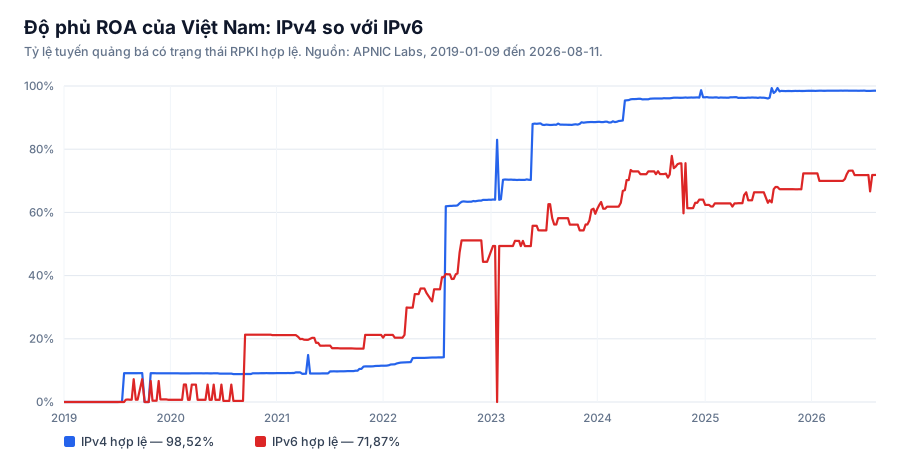
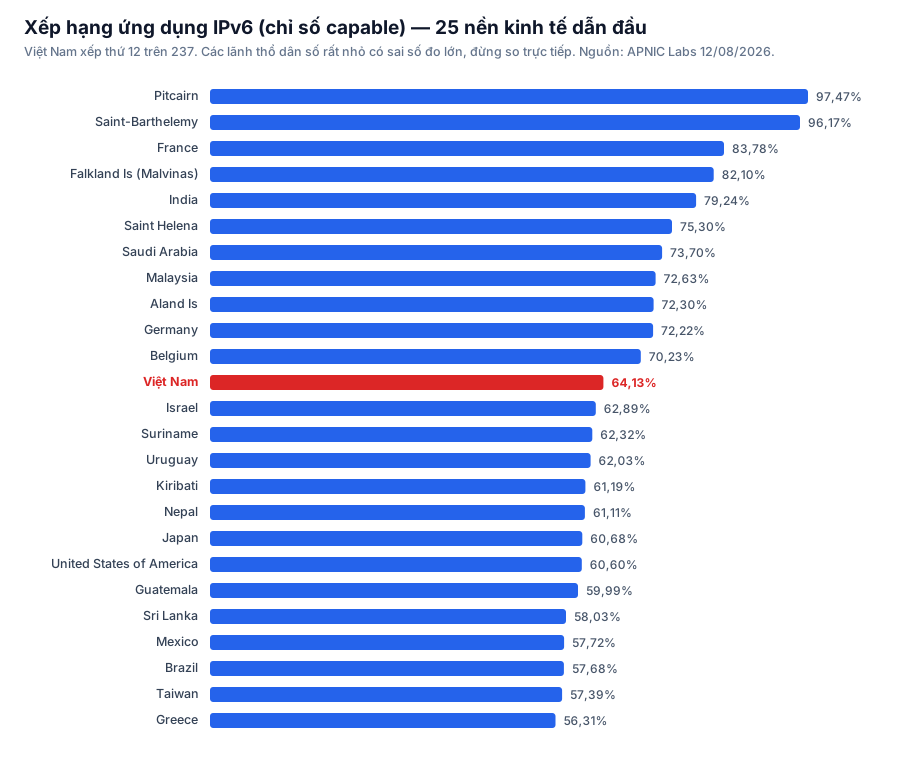
Real-time Vietnamese figures for IPv6, DNS and routing are published at internetatlas.vnnic.vn.
Managing resources properly is not paperwork. It decides whether other networks trust and accept your traffic at all.
Whois and RDAP data, route objects, technical contacts and abuse contacts are declared correctly and kept current, so other networks know who to reach when something breaks.
Signing ROA under RPKI and publishing route objects on IRR helps prevent your routes from being impersonated and helps large networks accept your route advertisements.
Holding your own addresses and ASN means changing ISP does not force you to renumber everything, and you can connect to several carriers at once.
A transition plan aligned with the national program for 2026 – 2030, so you are not scrambling when IPv4 runs short or lease prices rise.
Peering at VNIX and international IXPs shortens the path to domestic and regional users instead of detouring through foreign transit.
Registration, transfer and reporting files are prepared under Decree 147/2024 and Circular 48/2025 as currently in force.
The competent authority is now the Ministry of Science and Technology. Many older instruments still carry the reference of the former Ministry of Information and Communications, so always check what remains in force rather than reusing an old document.
Sets the legal basis for managing and using Internet resources in Vietnam.
Management, provision and use of Internet services. Replaces Decree 72/2013 and Decree 27/2018. Article 9 governs domain name registration.
Management and use of Internet resources, replacing Circular 24/2015 and Circular 21/2021. Domain transfers are restricted during the first 60 days and the last 30 days of a registration cycle.
All fees and charges for domain names, IP addresses and autonomous system numbers.
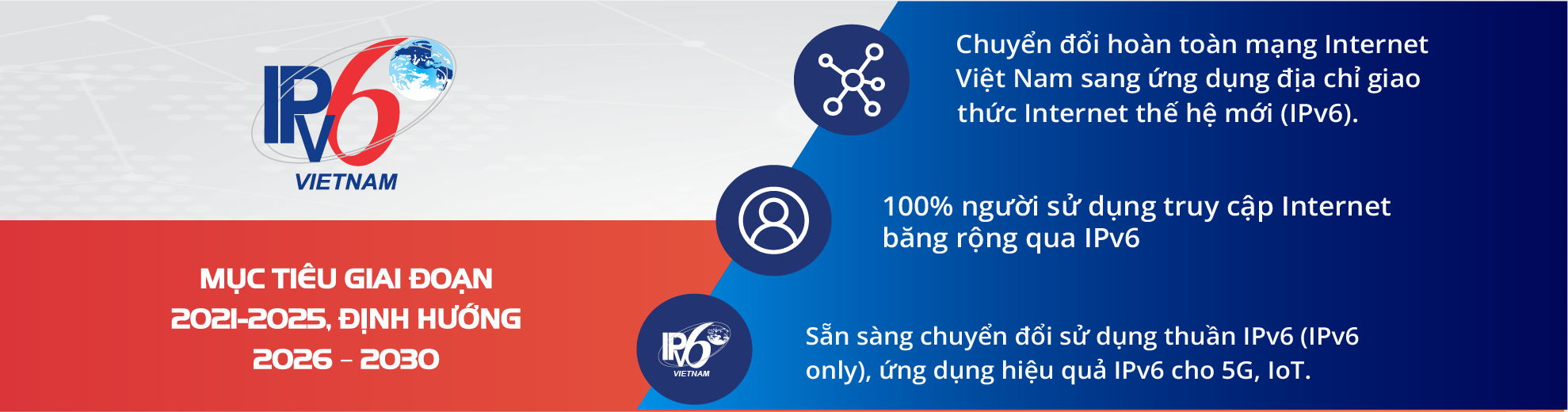
The IPv6-only program for 2026 – 2030, targeting 90% to 100% IPv6 adoption by 2030.
From the resource application to routing that actually runs in production, one team stays with it instead of splitting the work across vendors.
Assess actual need, pick a sensible block size, prepare the paperwork and stay with the registry process until the resource is allocated.
Build the multi-homing design, announcement policy, path redundancy and traffic steering for systems that need high stability.
Peering strategy, connections to VNIX, international IXPs, carriers and data centers to cut latency for your target users.
Sign ROAs for every resource, publish route and route6 objects, and set filters that limit the risk of route hijacks and route leaks.
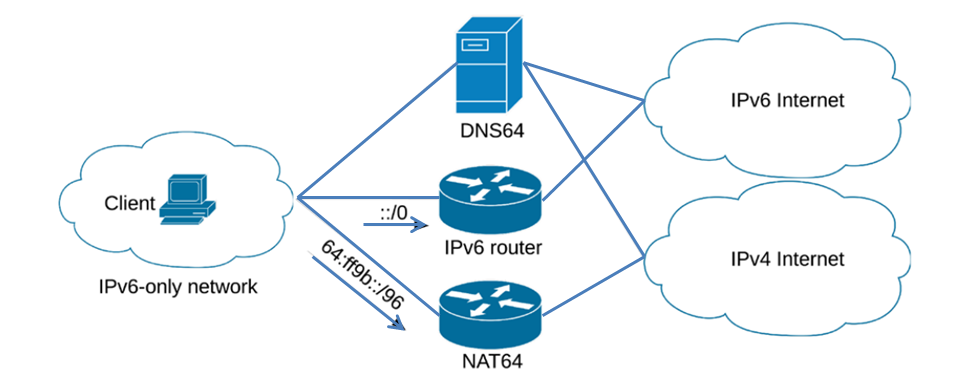
Address planning, dual-stack, NAT64, DNS64 and 464XLAT deployment, application testing, then a phased move to pure IPv6 operation.
Review of Whois and RDAP data, reverse DNS, abuse contacts, renewals and periodic reporting, plus network incident support throughout the resource lifecycle.
| Resources | Issued by | HiTechCloud provides |
|---|---|---|
| IPv4 addresses | VNNIC or APNIC | Assess need, prepare the application, and advise on leasing or transfer now that the IPv4 pool is exhausted. |
| IPv6 addresses | VNNIC or APNIC | Determine the right block size, plan the subnet structure and roll it out on real infrastructure. |
| Autonomous system numbers (ASN) | VNNIC or APNIC | Register a 16-bit or 32-bit ASN, declare the routing policy and bring up the first BGP session. |
| Reverse DNS (PTR records) | Delegation from registry | Configure the reverse zone for your address range, a hard requirement for any mail-sending system. |
| ROAs under RPKI | The registry holding the resource | Create and maintain ROAs that match what you actually announce, so a wrong ROA does not take your own routes down. |
| Route and route6 objects | IRR databases | Publish and maintain routing objects so the large networks accept your announcements. |
| IXP connectivity | VNIX and international IXPs | Meet the joining requirements, provision the port, bring up peering sessions and monitor quality. |
These four are the most commonly skipped when a business does this alone, and the ones behind the hardest incidents to diagnose later.
An IXP is neutral infrastructure where networks peer directly instead of routing through transit. For a business that already holds an ASN and independent IP addresses, this is the next step that makes the clearest difference to latency and bandwidth cost.
 VNIX
Vietnam national Internet exchange
VNIX
Vietnam national Internet exchange
 HKIX
Hong Kong Internet Exchange
HKIX
Hong Kong Internet Exchange
Traffic between two networks present at the same IXP goes straight across the exchange instead of detouring through international transit, cutting both latency and hop count.
Traffic exchanged directly does not count against the transit capacity you have to buy, which is usually the main economic reason a network joins an IXP.
The organization must hold an ASN and an independent IP address range allocated by VNNIC, then provision a physical port at a point of presence and bring up peering sessions.
More than 30 member networks, 5 points of presence nationwide and over 400 Gbps of exchange capacity for domestic traffic.
This is the layer that sets the policy framework every registry above operates under. Businesses do not deal with these bodies directly, but their decisions shape the conditions for obtaining and keeping resources.
 ICANN
Global coordination of names and numbers
ICANN
Global coordination of names and numbers
 NRO
The joint forum of the five RIRs
NRO
The joint forum of the five RIRs
 APTLD
Asia Pacific ccTLD association
APTLD
Asia Pacific ccTLD association
Allocation rules are not set by any single company. They emerge from an open policy development process at each RIR, where every member can propose and vote.
When policy changes, so do the conditions for obtaining, transferring and maintaining resources. Tracking this framework keeps your records from going out of date midway.
HiTechCloud tracks policy changes at RIR and NIR level and translates them into the specific actions your business needs to take on its own resource records.
They need independent addresses and an ASN to run BGP with two or more providers, keeping services up when one path fails.
They sub-allocate to customers, so they need a clear addressing plan and clean registry records from day one.
They require tight control of traffic paths, validated routing and the ability to prove ownership of their resources.
Carrying out the transition for IT systems and public service portals under the national IPv6 program.
They need resources and connectivity across several RIR regions, with a peering strategy suited to each market.
They need address ranges with clean history, correct reverse DNS and clear abuse records so their mail is not marked as spam.
Record the infrastructure model, traffic, user regions, resources in use and growth plans.
Decide which resources and what size to register, the routing and connectivity design, and the cost that comes with it.
Complete the documents the registry requires, justify the stated need and follow it through to allocation.
Configure BGP, establish peering, sign ROAs, publish route objects and set up reverse DNS.
Verify the real forwarding path, failover when one route is lost, and the validity of the routing data.
Monitor path quality, keep records current, renew resources and stay alongside you as the system grows.
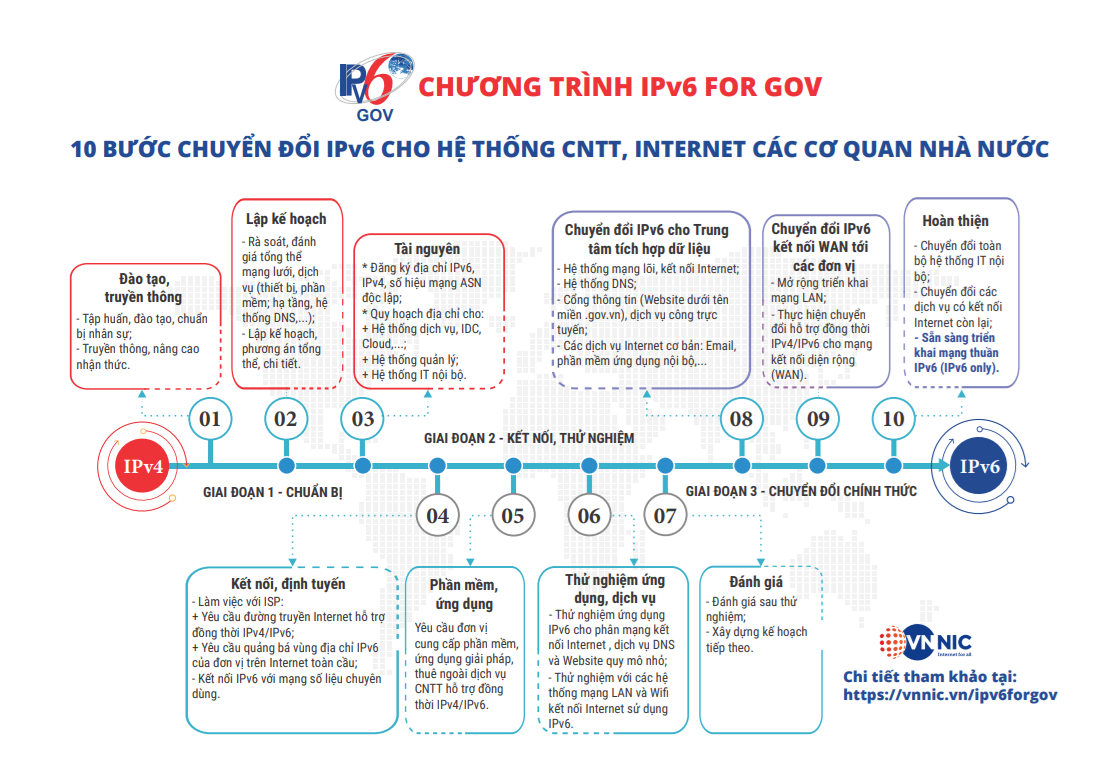
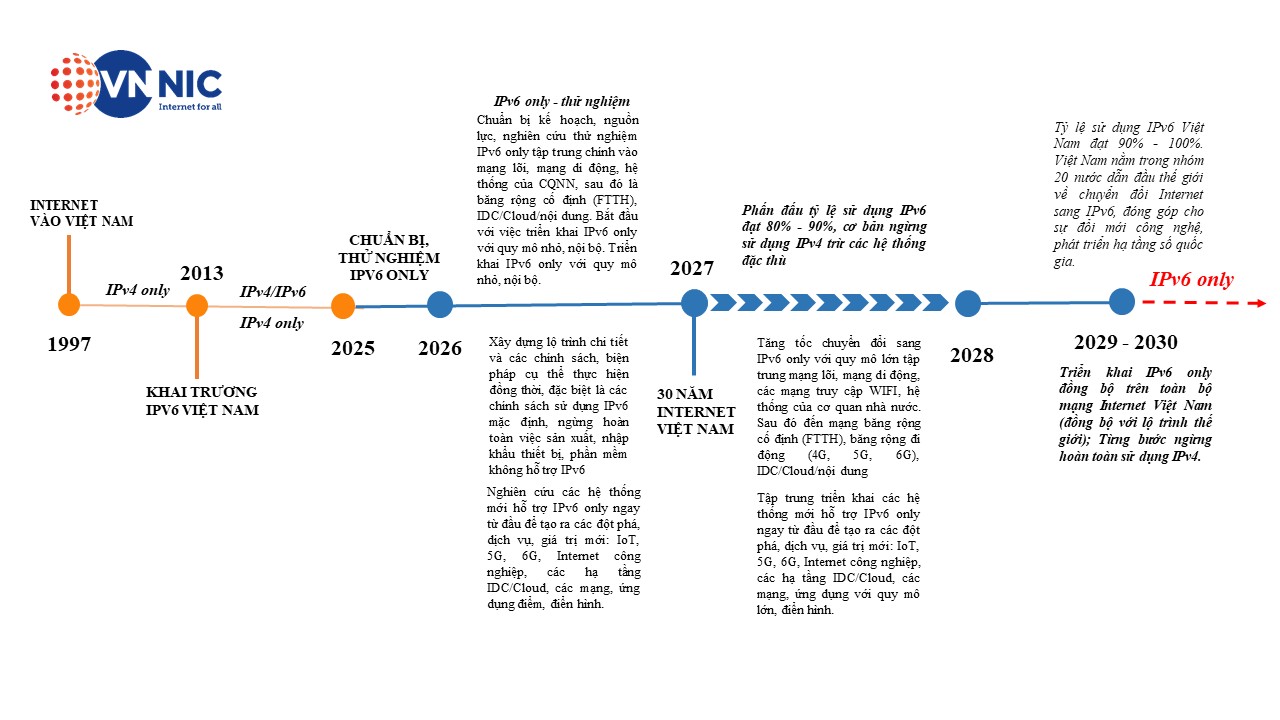
HiTechCloud started this roadmap in 2023 and is currently in the IPv6-only proof-of-concept and pilot phase of the 2025 – 2026 cycle. The later phases follow the national IPv6-only program for 2026 – 2030 set out in Decision 3369/QD-BKHCN, broken into steps that can be carried out without taking services down.
HiTechCloud’s roadmap follows the national program below. Both figures are published by the Vietnam Internet Network Information Center, shown here so a business can line its own milestones up against the national ones.
No. If you use a single provider, the addresses they assign are enough. Independent registration only becomes necessary when you want to connect to several carriers, run BGP yourself, or avoid renumbering every time you change provider.
The global IPv4 pool is exhausted, so registries now issue only very small blocks under restrictive policy, usually with a waiting list. In practice a business needing more IPv4 has to lease or acquire it by transfer, and should start planning IPv6 in parallel.
Fees and charges are set by Circular 10/2025/TT-BTC. IP addresses are charged by band according to how many addresses you hold; if your IPv4 and IPv6 holdings fall in the same band only one fee applies, so enabling IPv6 usually does not raise your resource cost. ASNs attract a charge from the third number onwards. Contact HiTechCloud for a quote matched to the exact block your business needs.
It depends on how complete the application is and how quickly the registry reviews it. The longest part is usually demonstrating a real routing need, such as a commitment to connect to at least two other networks. HiTechCloud prepares that part with you before filing.
The two complement each other. A route object in the IRR is declared data, while a ROA under RPKI is a digital signature vouched for by the registry that allocated the resource. More and more large networks drop RPKI-invalid routes, so no ROA means losing reachability to part of the Internet.
No, provided you deploy NAT64 and DNS64 alongside it. Those translate traffic for IPv6-only clients whenever the destination is IPv4-only. Testing applications before the switch is still mandatory, because some older software hard-codes IPv4 addresses in its configuration.
The hard requirement is that the organization holds an ASN and an independent IP address range allocated by VNNIC. After that comes the physical port at one of the points of presence and peering sessions with the other members.
The Ministry of Science and Technology, through the Vietnam Internet Network Information Center (VNNIC). Many older instruments still carry the reference of the former Ministry of Information and Communications, so always check what remains in force.
HiTechCloud links straight to the origin rather than copying figures, because every number on this page changes over time.
Send us your current setup and your goals, and HiTechCloud will propose a resource, routing and connectivity plan that fits.






















































































































Start deploying quickly with HiTechCloud
Announcements, in-depth analysis and events


















































Start building with HiTechCloud and shape a complete AI and cloud strategy
Sign in to explore an ecosystem of over 30 products and utilities designed for you
Get started
Connect with our sales team and explore optimal AI & Cloud solutions for your enterprise
Contact sales